
What Is a DSCR Loan and Why Do Real Estate Investors Love Them?
If you’ve spent any time in real estate investor forums or talking with other landlords, you’ve probably heard someone mention a DSCR loan real estate investors use to qualify for financing without handing over years of tax returns or pay stubs.
It sounds almost too simple: instead of the lender scrutinizing your personal income, they look at whether the property itself brings in enough rent to cover the mortgage payment. That single shift — from “can you afford this?” to “can the property afford this?” — is why DSCR loans have become one of the most talked-about tools in the rental investing world.
If you’re self-employed, own multiple properties, or your tax returns don’t tell the full story of your financial picture (thanks to write-offs and depreciation), this financing structure can feel like a breath of fresh air. Let’s break down exactly what a DSCR loan is, how the math works, and whether it’s the right fit for your next deal.
What Is a DSCR Loan?
DSCR stands for Debt Service Coverage Ratio. In plain English, a DSCR loan is a type of real estate financing where the lender qualifies you based on the cash flow the rental property generates, rather than your personal income, employment history, or debt-to-income ratio.
Traditional mortgages ask: “Does this borrower earn enough to cover this payment, based on tax returns and W-2s?” A DSCR loan real estate transaction asks a different question entirely: “Does the rental income from this specific property cover its own mortgage payment?”
This makes DSCR loans especially popular with investors who hold properties inside an LLC, who have multiple financed properties already on their personal credit profile, or whose tax returns show reduced income due to depreciation and other legitimate deductions. Because the underwriting is centered on the asset rather than the individual, a DSCR loan real estate strategy has become a go-to option for investors scaling a rental portfolio.
How the DSCR Ratio Is Calculated
The formula itself is straightforward:
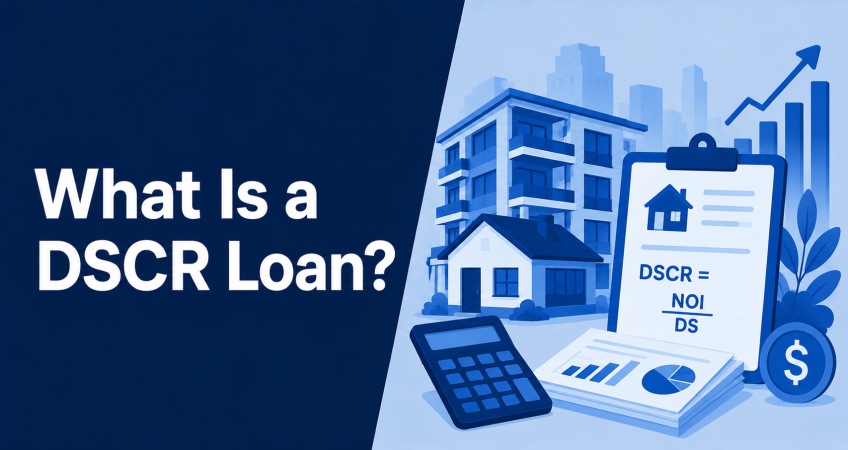
DSCR = Gross Rental Income ÷ Total Debt Service (PITIA)
“Total debt service” typically includes principal, interest, taxes, insurance, and (if applicable) association dues — often abbreviated as PITIA. Let’s walk through an illustrative example using placeholder numbers (these are for demonstration only, not real loan terms):
- Example monthly rental income: $2,500
- Example monthly PITIA (principal, interest, taxes, insurance): $2,000
DSCR = $2,500 ÷ $2,000 = 1.25
A DSCR of 1.25 means the property generates 25% more income than it costs to service the debt each month — in this illustrative example, there’s a comfortable cushion above break-even.
Here’s how to read the ratio in general terms:
- DSCR above 1.0 — the property’s income exceeds its debt obligations (illustrative example only)
- DSCR at exactly 1.0 — the property’s rental income breaks even with the mortgage payment (illustrative example only)
- DSCR below 1.0 — the property’s rental income falls short of covering the mortgage payment (illustrative example only)
Every lender sets its own minimum DSCR threshold, and those minimums — along with rates, terms, and reserve requirements — vary by lender and can change based on market conditions, property type, and loan program. Don’t treat any specific ratio or rate you see online as universal; always confirm current guidelines directly with a lender before assuming you qualify.
Why Investors Love Them
It’s easy to see why a DSCR loan real estate approach has caught on so widely among landlords and portfolio investors. A few of the biggest draws:
No tax returns or W-2s required. Since qualification is based on the property’s cash flow rather than your personal income documentation, self-employed investors and those with complex tax situations often find the process far less invasive.
Scalable for growing portfolios. Because each property is evaluated on its own merits, investors aren’t as limited by the number of financed properties already showing up on their personal credit profile. This makes it easier to keep adding doors without hitting the same walls that come with conventional financing caps.
Great fit for LLCs. Many DSCR loan real estate programs allow properties to close in the name of an LLC or other business entity, which can support an investor’s asset protection and liability strategy — something conventional residential mortgages often don’t accommodate.
Faster, more predictable underwriting. Because the analysis centers on one clear ratio tied to the property rather than a deep dive into an investor’s full financial history, the process can feel more streamlined for experienced investors who know their numbers.
Taken together, these advantages explain why a DSCR loan real estate strategy has become a foundational tool for buy-and-hold investors, house hackers turned landlords, and anyone building a serious rental portfolio.
Who a DSCR Loan Is (and Isn’t) Right For
DSCR loans tend to be a strong fit for:
- Investors purchasing or refinancing rental properties with steady or projected rental income
- Self-employed borrowers whose tax returns don’t reflect their true cash position
- Investors who already hold several financed properties and are running into conventional lending limits
- Those who want to hold title in an LLC for liability protection
They may be less suitable for:
- Primary residence purchases — DSCR loans are designed for investment properties, not owner-occupied homes
- Properties with little to no rental history or highly uncertain income projections, since the entire qualification hinges on that cash flow
- First-time buyers with no experience managing rental property, who may benefit more from a conventional loan program while they build a track record
If your situation checks a few of these boxes, it’s worth having a real conversation about whether a DSCR loan real estate structure lines up with your investment goals and the specific property you’re eyeing.
Ready to See If a DSCR Loan Fits Your Next Deal?
DSCR loans have earned their popularity for a simple reason: they let the property’s performance speak for itself. No mountains of pay stubs, no explaining away tax write-offs — just a clear look at whether the numbers work.
Every lender’s guidelines, rates, and minimum ratios differ, so the best next step is to talk to someone who can walk through your specific property and goals. See if you qualify for a DSCR loan and find out what your numbers could look like.
One comment
Comments are closed.
September 18, 2026
[…] taxes, insurance, and any HOA fees). Instead of qualifying based on your personal income, a DSCR loan qualifies based on whether the property’s own cash flow can cover the debt. This makes it a […]